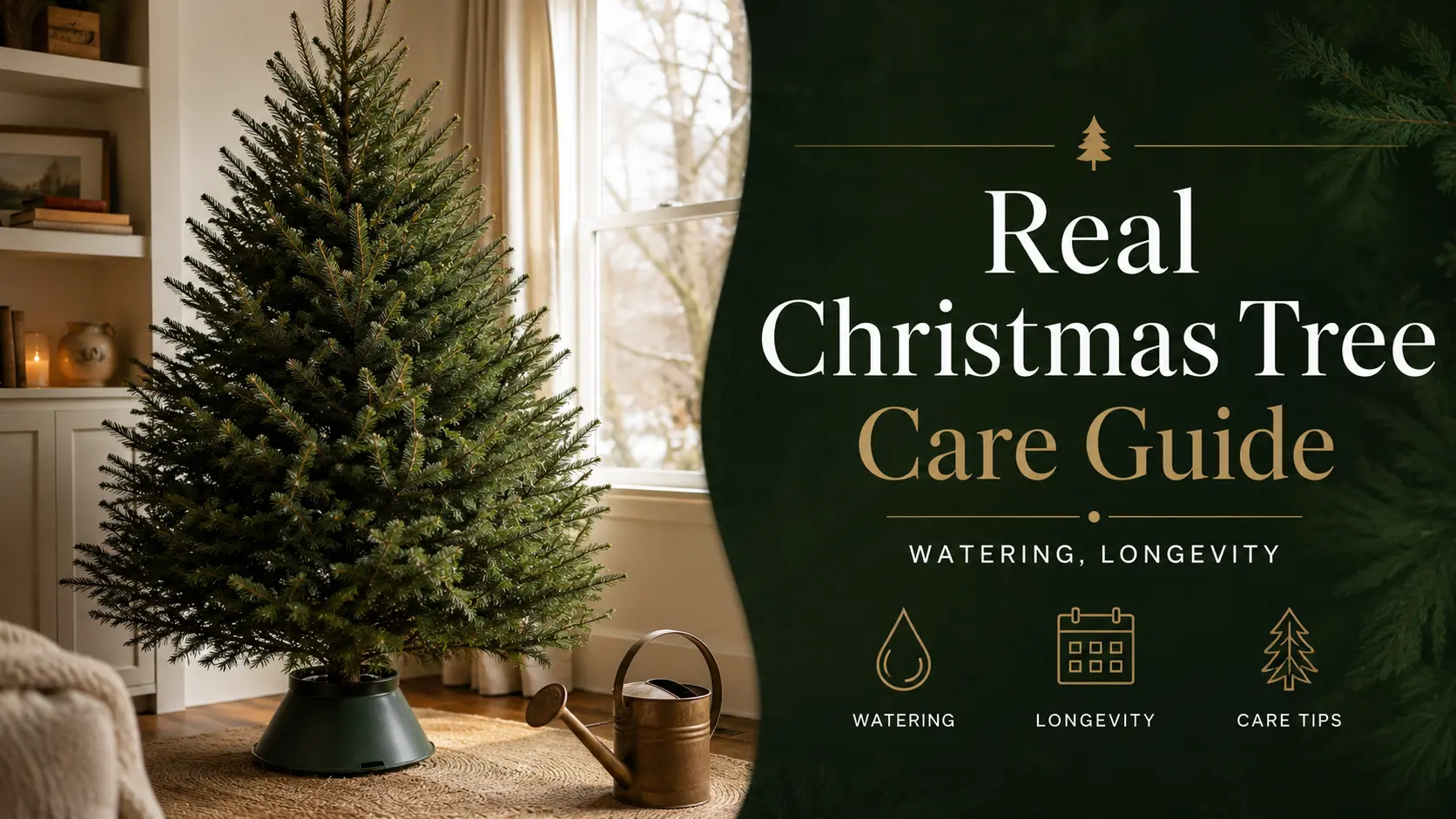

A real Christmas tree can be one of the most beautiful things you bring into your home during the holidays. The scent alone is worth it. But there is a real difference between a tree that stays lush and green through the new year and one that starts dropping needles by December 15th. That difference comes down almost entirely to how you care for it.
Some people buy a great tree, set it up in a warm corner, forget to water it for two days, and then wonder why it looks miserable by Christmas Eve. Others get a mediocre tree from a lot that has been sitting out for three weeks, give it a fresh cut, keep the water topped off, and enjoy a tree that lasts well past New Year’s Day.
This guide covers everything you need to know about real Christmas tree care, from choosing a fresh tree at the lot to daily watering habits and placement tips that can add weeks to your tree’s life. Whether this is your first real tree or your fiftieth, there is something here that will help you keep it healthier for longer.
What Determines How Long a Real Christmas Tree Lasts?
Before getting into the how-to, it helps to understand why trees dry out at different rates. Several factors work together, and ignoring any one of them can cut your tree’s lifespan significantly.
Tree species plays a bigger role than most people realize. Some species have naturally oilier needles and tighter cells that retain moisture longer. Fraser Fir, for example, is known for excellent needle retention. Scotch Pine tends to dry out faster. The species you choose sets a ceiling on how long your tree can realistically last under ideal conditions.
Freshness at purchase is arguably the most important variable. A tree that was cut a week ago and left on a dry lot with no water has already lost a significant portion of its moisture. When the cut end dries, it seals over with resin, blocking water uptake. That tree is already behind before you get it home. A freshly cut tree, or one that has been kept in water at the lot, starts from a much better position.
Climate and indoor conditions interact in ways most people underestimate. Central heating systems pull humidity from the air, and dry air pulls moisture from your tree. A tree in a dry, heated house will dehydrate faster than one in a more humid environment. Homes in cold climates that run heavy forced-air heat are especially challenging.
Placement matters too. Trees near heat vents, fireplaces, or direct sunlight lose moisture exponentially faster. A tree in a cool corner of the room, away from heat sources, will outlast an identical tree positioned next to a radiator by several weeks.
Watering habits tie all of this together. Even the freshest tree of the best species will dry out in days if the water reservoir runs dry. Consistent watering is the single most reliable way to extend christmas tree longevity.
How Long Does a Real Christmas Tree Typically Last?
Here is a realistic look at what to expect from the most common tree species under reasonably good care conditions, meaning a fresh cut, consistent watering, and moderate indoor temperatures.
| Tree Species | Typical Indoor Lifespan | Needle Retention | Notes |
|---|---|---|---|
| Fraser Fir | 5 to 7 weeks | Excellent | The gold standard for longevity; holds needles even when dry |
| Noble Fir | 5 to 6 weeks | Excellent | Strong branches, good for heavy ornaments |
| Balsam Fir | 4 to 5 weeks | Good | Stronger fragrance; slightly shorter lifespan than Fraser |
| Douglas Fir | 3 to 5 weeks | Moderate | Less forgiving if watering is inconsistent |
| Scotch Pine | 3 to 4 weeks | Moderate | Holds needles when dry but loses freshness faster |
These ranges assume the tree was reasonably fresh at purchase and is watered daily. Poor care can cut these times nearly in half. Exceptional care, particularly in a cool, humidified room, can push past the upper end.
If you typically put your tree up the first weekend of December and take it down around New Year’s, you are looking at roughly four weeks. A Fraser Fir or Noble Fir will handle that comfortably. A Douglas Fir or Scotch Pine might look tired by Christmas without extra attention.
Choosing a Fresh Tree From the Start
Good christmas tree care begins before you even get the tree home. A poor choice at the lot cannot be fully corrected with great watering habits.
The needle retention test is simple. Run your fingers along a branch and let the needles slide through. A fresh tree will shed very few. If needles fall in clumps or the branch looks noticeably sparse, the tree has already lost too much moisture. For Firs, a gentle bend of a needle between your fingers should result in a clean snap, not a limp fold.
Branch flexibility tells you a lot about internal moisture. Gently bend a smaller outer branch. A fresh tree’s branches spring back. Dry branches feel stiff and may crack. The whole canopy should feel supple, not brittle.
Trunk condition is worth examining up close. Look at the cut end if you can see it. Is it sticky with fresh resin, or has it dried out and turned gray? A gray, dried cut has sealed over and will need a fresh cut before the tree can absorb water. Check also that the trunk is straight enough to fit properly in your stand.
Color should be deep and consistent. Yellowing or browning patches in the interior are normal, but yellowing on the outer tips of branches indicates stress or dehydration. Avoid trees with faded, pale, or blueish needles.
If you are deciding between tree sizes and heights for your space, it is worth reviewing what height Christmas tree you should buy for your home before heading to the lot, so you are not guessing in the cold.
The First 24 Hours Matter Most
What you do in the first day after bringing your tree home has more impact on its longevity than almost anything else you do afterward.
Step 1: Make a fresh cut immediately. If you did not get a fresh cut at the lot, make one yourself as soon as you get home, ideally within an hour. Use a handsaw or reciprocating saw to remove at least half an inch from the bottom of the trunk, cutting straight across. Do not cut at an angle. An angled cut reduces the surface area for water uptake without providing any benefit.
Step 2: Get the tree into water within an hour of cutting. Once you make a fresh cut, the clock is ticking. Resin begins sealing the cut surface quickly. If you cannot set the tree up right away, place the trunk in a bucket of water in your garage or outside in cool temperatures until you are ready. Do not let it sit dry.
Step 3: Fill the reservoir immediately and check it within the first few hours. A freshly cut tree can drink an extraordinary amount of water in the first 24 hours, sometimes more than a quart per hour for a large tree. This is not a moment to fill the stand and walk away until tomorrow morning.
Step 4: Keep the room cool while the tree acclimates. If possible, set up the tree in a room that has not been heavily heated. Give it a few hours to stabilize before turning up the thermostat. Gradual temperature change is gentler on the tree.
Do not decorate immediately. Let the tree settle into the stand, confirm the water level is holding, and allow the branches to drop fully before adding lights and ornaments.
How Much Water Does a Real Christmas Tree Need?
This is where most people go wrong. They fill the stand once, assume it is fine, and check it again two days later to find the reservoir completely empty and the trunk sitting in air.
The general rule is that a tree will consume approximately one quart of water per inch of trunk diameter per day, especially in the first week. A tree with a four-inch diameter trunk may drink a gallon of water daily when freshly cut. As the tree ages and slows its water uptake, consumption decreases, but you should never let the water drop below the base of the trunk.
Here is a practical guide by tree size:
| Tree Height | Approximate Trunk Diameter | Estimated Daily Water Need | Minimum Stand Reservoir |
|---|---|---|---|
| 4 to 5 feet | 2 to 3 inches | 0.5 to 0.75 gallons | 1 gallon |
| 6 to 7 feet | 3 to 4 inches | 0.75 to 1 gallon | 1.5 gallons |
| 8 to 9 feet | 4 to 5 inches | 1 to 1.5 gallons | 2 gallons |
| 10 feet and above | 5 to 6+ inches | 1.5 to 2+ gallons | 3+ gallons |
Daily watering schedule: Check the water level every morning and again each evening for the first two weeks. After that, a once-daily check is usually sufficient. Never let the water level drop below the base of the trunk. Once the cut surface is exposed to air again, it begins resealing, and water uptake becomes less efficient.
Common mistakes to avoid:
- Filling the stand once and assuming it will last for days
- Using a stand with a reservoir that is too small for the tree
- Adding the wrong substances to the water (more on this below)
- Neglecting to check after the tree has been up for a few weeks, assuming it no longer needs as much water
Signs of dehydration include needles that feel dry or papery rather than slightly waxy, branches that droop more than usual, needles that fall with a light touch rather than staying attached, and the water level in the stand dropping more slowly, which paradoxically indicates the tree is no longer able to drink effectively.
Best Christmas Tree Stands for Water Retention
Your stand is not just a support structure. It is a water delivery system, and a poorly sized stand can undermine every other care effort you make.
The most important feature is reservoir capacity. A stand that holds only half a gallon will need refilling multiple times a day for a large, thirsty tree. Look for stands rated for the height of your tree, and then check the actual reservoir volume in the product specifications. Many stands are rated by height but have reservoirs that are too small for the trunk diameter they can accommodate.
Stability matters especially for taller trees with heavy ornaments. A wobbly stand is a safety risk and also causes stress on the trunk that can affect water uptake. Look for stands with wide bases and multiple adjustment points.
Ease of access is underrated. If filling the stand requires a funnel and a flashlight because the opening is buried under branches, you are less likely to do it consistently. Some stands have extended fill tubes or side-accessible reservoirs that make daily watering much easier.
For those looking at larger specimens, a dedicated 10-foot Christmas tree needs a stand with a reservoir of at least 2.5 to 3 gallons and a base wide enough to handle the weight and leverage of a full-sized tree. Do not try to use a standard 7-foot stand for a 10-foot tree. The reservoir will be too small and the stability insufficient.
Where to Place Your Christmas Tree
Placement is a care decision that gets made once but affects the tree every hour of every day it is up.
Avoid heat vents and radiators. This is the single most common placement mistake. Forced hot air directed at a tree accelerates moisture loss dramatically. Even a vent that is not directly blowing on the tree but is within a few feet can raise the ambient temperature around it enough to matter. Redirect vents if possible, or choose a placement away from them entirely.
Keep away from fireplaces. Beyond the moisture concern, a dry Christmas tree near an open flame is a serious fire hazard. Keep at least three feet of clearance from any fireplace, and make sure the tree is fully watered at all times if it must be near a heat source.
Sunlight concerns. A window that receives strong afternoon sun can heat up a corner of your room significantly. Direct sunlight on the tree will warm the needles and accelerate drying. North-facing or interior placements are ideal. If your only good spot is near a sunny window, consider keeping curtains or blinds partially closed during peak sun hours.
Humidity considerations. If your home is particularly dry, especially in winter when heating systems run constantly, a humidifier placed near the tree can meaningfully extend its life. Even raising the relative humidity in that room by 10 to 15 percent reduces the rate at which the tree loses moisture to the air.
How to Keep a Real Christmas Tree Fresh Longer
Beyond the basics, there are several specific strategies that can add meaningful time to your tree’s life.
Consistent watering remains the foundation. There is no substitute. Every other tip in this section compounds the benefits of good watering habits, but none replaces them. Set a daily reminder on your phone if you need to.
Room temperature control makes a measurable difference. Trees kept in rooms around 65 degrees Fahrenheit or slightly below last noticeably longer than trees in rooms kept at 72 or above. If you have the option to keep the tree in a cooler part of the house, or to lower the thermostat slightly in the evenings, do it.
Humidity management. Beyond a standalone humidifier, there are simpler approaches. A bowl of water placed near the tree adds modest ambient humidity. Grouping houseplants nearby can help slightly. Even keeping interior doors open to allow air circulation prevents the tree from sitting in a particularly stagnant, dry pocket of air.
Proper lighting choices have more impact than people expect. Traditional incandescent lights generate heat. LED lights run far cooler and are significantly better for keeping christmas tree fresh. If you have older incandescent strands, switching to LED is one of the most straightforward upgrades you can make for both energy savings and tree longevity. If you are also thinking about the lighting setup itself, a dedicated Christmas tree lights and lighting guide is worth reviewing before you start stringing.
Common Christmas Tree Watering Myths
There is a persistent body of folklore around Christmas tree watering additives. Most of it is well-intentioned but unsupported by evidence.
Sugar water. The theory is that adding sugar feeds the tree and helps it stay alive longer. Research does not support this. Trees do not absorb and metabolize sugar from water the way this idea implies, and dissolved sugar can actually promote bacterial growth in the water, which can clog the tree’s uptake pathways. Use plain water.
Aspirin. Some people add aspirin to the water, presumably because salicylic acid has plant-related functions. Studies from university extension programs have not found that aspirin meaningfully extends tree life compared to plain water. It is not harmful in small amounts, but it is not helpful either.
Soda and corn syrup. Both have been suggested as additives. The sugar concern from above applies equally here. Additionally, the carbonation in soda does nothing useful and the high sugar content actively encourages bacterial and mold growth.
Commercial tree preservatives. These products, usually sold at tree lots and garden centers, claim to extend tree life and are generally safe to use. Some contain anti-transpirants, anti-bacterial agents, or mild sugars. The evidence for their effectiveness is mixed. University studies generally find that plain, clean water works as well as commercial additives for trees that receive consistent watering. The best preservative is simply never letting the reservoir run dry.
The bottom line is straightforward: plain water, changed or topped off regularly with consistent levels, is all your tree needs.
Signs Your Tree Is Drying Out
Catching dryness early gives you a chance to correct it. Waiting until the tree looks completely dead means you are well past the point of recovery.
Needle drop is the most obvious sign. All trees drop some needles, particularly interior ones, throughout the season. What you are watching for is accelerated outer needle drop, especially when you brush against or decorate around the tree. If needles fall freely with minimal contact, the tree is already significantly dehydrated.
Branch brittleness is an early warning sign that often precedes visible needle drop. Healthy branches flex slightly; drying branches feel stiff and may audibly crack when bent. Run a hand under a lower branch and gently flex it upward. It should offer resistance without cracking.
Color changes are gradual but telling. Deep green needles shifting to a lighter, more yellowish green, or taking on a dry, dusty appearance, indicate moisture loss. This is often most visible on branches near heat sources or in direct light.
Reduced water absorption is a counterintuitive sign. If the water level in your stand stops dropping as quickly as it did in the first week, that is not necessarily good news. It may mean the tree can no longer absorb water effectively, either because the cut has resealed, the trunk is blocked by bacterial buildup, or the tree has passed a threshold of dryness. If you notice this alongside other signs, the tree may be near the end of its useful life.
Real vs. Artificial Trees: Which Lasts Longer?
This is genuinely a case where the right answer depends on what you mean by “last longer.”
A real tree, properly cared for, typically remains fresh and beautiful for four to seven weeks depending on species and conditions. After that, it needs to be taken down and disposed of.
An artificial tree, by contrast, can last many years with proper storage. The question of how long artificial Christmas trees last depends heavily on quality and how they are stored, but a well-made artificial tree stored correctly can remain usable for 10 to 20 years.
From a seasonal convenience standpoint, artificial trees win on longevity without question. You assemble them, use them for weeks, then store them until the following year. There is no watering, no needle cleanup, no disposal.
From a sensory and experiential standpoint, real trees offer things an artificial tree cannot replicate: genuine fragrance, natural variation in shape, and a living quality that many people find more meaningful. These are not trivial considerations for many families.
The comparison ultimately comes down to personal priorities, how you weigh convenience, cost over time, sensory experience, and environmental considerations.
Environmental Considerations
The environmental comparison between real and artificial trees is more nuanced than it first appears.
Real Christmas trees are grown on farms, typically over seven to ten years, and are renewable by nature. Christmas tree farms provide wildlife habitat, absorb carbon dioxide during growth, and support local agricultural economies. After the holidays, real trees can be mulched, composted, used in erosion control, or sunk in ponds as fish habitat. Many municipalities offer curbside tree recycling in January specifically for this purpose.
The carbon footprint of a real tree includes farming inputs, irrigation, pesticide use, and transportation to the consumer, but the relatively short supply chain for trees grown and sold regionally is considerably better than for products manufactured overseas.
The environmental picture for artificial trees is complicated. Most are manufactured in China, shipped long distances, and made from PVC plastic and metal, both of which require significant energy to produce and do not biodegrade. The full question of whether artificial Christmas trees are eco-friendly is worth reading through carefully if this matters to your purchasing decision, as the answer depends heavily on how many years the artificial tree is actually used.
If you keep an artificial tree for 10 or more years, the per-year environmental impact decreases substantially. If it gets used three or four times and discarded, the impact is considerably worse than a real tree.
Decorating Without Shortening Tree Life
The way you decorate interacts directly with how long your tree stays fresh. A few small decisions make a meaningful difference.
Heat from lights is the most significant decorating factor. As mentioned earlier, LED lights run far cooler than incandescent strings. If you are committed to incandescent for their warmth and glow, at minimum do not leave them on when you are not home or while you sleep. Constant incandescent heat accelerates drying and creates a fire risk as the tree ages.
When you are shopping for a tree that already comes with lights installed, pre-lit options that use LED technology offer the best combination of convenience and tree health. You can explore pre-lit Christmas trees to see options that balance aesthetics with lower heat output.
Ornament weight is a secondary concern but worth noting. Heavy ornaments pull branches downward, which can stress branch connections and create uneven water distribution in the canopy. Spread heavier ornaments toward the interior of the tree where branches are thicker and more supported. Reserve outer branch tips for lightweight ornaments.
Safety considerations go hand in hand with tree care. An older, drying tree is significantly more flammable than a fresh, well-watered one. Turn off all tree lights when leaving the house. Do not run lights overnight. Keep a water source nearby. These are habits that protect both your tree and your home.
Care Tips for Large Real Christmas Trees
Larger trees bring their own specific set of care challenges that go beyond simply scaling up the advice for a smaller tree.
Water demand is disproportionately higher for large trees. A 9 or 10-foot tree with a wide trunk can easily drink two gallons of water in a day when freshly cut and set up. This means checking the reservoir twice a day in the first week is not overcautious, it is necessary. Running dry even once can meaningfully shorten the tree’s lifespan.
Stability becomes a real concern with full-sized trees. A 9-foot Christmas tree carries significant weight and has a high center of gravity. The stand must have a wide base and strong clamping capability, and it should be positioned away from foot traffic. For added security, some people anchor tall trees to a wall with a clear wire or fishing line run through an eye hook, which is nearly invisible and highly effective.
Maintenance access. The larger the tree, the harder it is to reach the stand reservoir without getting under branches and getting pine sap on everything. Consider a stand with an extended fill tube or a dedicated watering funnel with a long nozzle before you put up a large tree, rather than after.
Also be mindful of heat stratification. In a room with high ceilings, the upper portions of a tall tree can be considerably warmer than the lower portions, especially near ceiling light fixtures. This can cause the top third of the tree to dry out faster than the base, which is worth watching.
Common Mistakes That Kill Christmas Trees Early
A quick summary of the most preventable errors in fresh cut christmas tree care:
Not watering enough, or at all. This is the single leading cause of premature tree death. Fill the stand before anything else after setting up the tree, and check it daily without exception.
Skipping the fresh trunk cut. A tree that has been sitting dry at a lot, even for a few hours, has begun resealing its cut end. Without a fresh cut, water uptake is severely limited from day one.
Choosing a stand with too small a reservoir. A stand rated for a six-foot tree with a half-gallon reservoir is not adequate for an eight-foot tree. Match the stand to the actual size and trunk diameter of your tree.
Placing the tree near heat sources. Fireplaces, heat vents, space heaters, and sunny windows all accelerate moisture loss. Poor placement is a daily compounding problem that you cannot compensate for through watering alone.
Buying a tree that was already old at the lot. No amount of care rescues a tree that was cut three weeks ago and stored dry. Start with freshness and everything else is easier.
Adding things to the water. Sugar, soda, aspirin, and bleach are all sometimes suggested as additives. Plain water is the correct choice. Additives can at best do nothing and at worst create bacterial problems that impede water uptake.
Not securing a large tree properly. A tipping tree is not just a safety hazard. The disruption to the stand, spilled water, and potential damage to the trunk can significantly shorten the tree’s life.
Real Christmas Tree Maintenance Checklist
A practical daily and weekly routine for keeping your tree in the best possible condition.
Day of setup:
- Make a fresh cut removing at least half an inch from the trunk
- Place in stand and fill reservoir immediately
- Keep room temperature moderate during initial acclimatization
- Do not decorate for several hours until tree has settled
Daily:
- Check water level in the morning (and again in the evening for the first two weeks)
- Refill to the top of the reservoir before the water level drops below the trunk base
- Check that no lights have been left on unattended
- Look over lower branches for any signs of unusual needle drop
Weekly:
- Inspect outer branches for color changes or brittleness
- Check stand stability, particularly after children or pets have been near the tree
- Assess whether the tree is still drinking well or if uptake has slowed
- Consider running a cool-mist humidifier nearby if the air feels particularly dry
Before and after decorating:
- Ensure water is topped off before adding ornaments and lights
- Turn off lights when leaving the house or going to bed
- After the holidays, check your storage setup for any pre-lit components following guidance from resources like how to store a pre-lit Christmas tree after the holidays
Conclusion
A real Christmas tree that lasts through the season and beyond is not the result of luck or buying an exceptional tree. It is the result of consistent, straightforward care applied from the moment you choose the tree at the lot to the day you take it down.
The core principles are not complicated. Start with a fresh tree from a reputable source. Make a fresh cut before the tree goes in the stand. Keep the reservoir filled with plain water, every single day, without exception. Place the tree away from heat sources. Use LED lights to minimize heat exposure. Keep the room at a reasonable temperature and consider a humidifier in dry conditions.
Species matters, but care matters more. A Fraser Fir with neglected watering will not outlast a Douglas Fir that is checked twice a day. The tree you have is the tree you care for, and the habits you build around christmas tree maintenance are what determine whether your tree looks magnificent on Christmas morning or tired and brittle by the 20th.
Take the first 24 hours seriously, stay consistent through the first two weeks when water demand is highest, and the rest of the season largely takes care of itself.
Frequently Asked Questions
Q: How often should I water my real Christmas tree?
A: Check the water level at least once a day, and twice daily for the first two weeks after setup. The goal is to keep the water level above the base of the trunk at all times. For a large tree, you may need to add water multiple times per day in the first week.
Q: What should I put in my Christmas tree water?
A: Plain, clean tap water is all you need. Additives like sugar, aspirin, soda, bleach, or commercial preservatives have not been shown to meaningfully extend tree life in controlled studies. Some can actually cause bacterial growth that impedes water uptake. Stick with plain water and focus on keeping the reservoir consistently full.
Q: Can a Christmas tree recover if the water runs dry?
A: It depends on how long the trunk was exposed to air. If the water level dropped below the trunk base for a few hours, a fresh cut can sometimes restore uptake. If the trunk was dry for a day or more, the cut surface will have resealed with resin and water uptake becomes very difficult. Prevention is far more effective than recovery.
Q: How do I know if my Christmas tree is still fresh when I buy it?
A: Run your fingers along a branch and check for excessive needle drop. Gently flex a small branch to see if it springs back. Look at the cut end of the trunk for signs of fresh, sticky resin rather than a dried, gray surface. Fresh trees should smell strongly of pine and have deep, consistent color throughout the canopy.
Q: Does the species of Christmas tree really matter for longevity?
A: Yes, meaningfully so. Fraser Fir and Noble Fir are the top performers for needle retention and longevity under indoor conditions. They can stay fresh five to seven weeks with good care. Douglas Fir and Scotch Pine are more forgiving of varying care but have shorter overall lifespans and less tolerance for dry conditions.
Q: Why is my tree not absorbing water after the first week?
A: Several things can cause this. The cut surface may have partially resealed, particularly if the water level dropped and exposed the trunk to air. Bacterial buildup in the reservoir can also clog the uptake channels. If you notice this, try making a fresh cut if feasible, clean the stand, and refill with fresh water. However, reduced uptake in the second and third weeks is also normal as the tree ages.
Q: Should I be concerned about fire safety with a real Christmas tree?
A: Yes, and this is directly related to tree care. A well-watered tree is significantly less flammable than a dry one. The National Fire Protection Association consistently identifies dry Christmas trees as a significant home fire risk. Keep the tree watered, use LED lights rather than incandescent, turn off lights when leaving or sleeping, and keep the tree at least three feet from heat sources and open flames.
Q: How should I dispose of my real Christmas tree after the holidays?
A: Many municipalities offer curbside Christmas tree pickup in the first weeks of January, with trees being chipped into mulch for public parks and gardens. You can also take your tree to a local drop-off site, contact a garden center that accepts trees for composting, or chip it yourself for garden mulch. Real trees are biodegradable and can even be used as wildlife brush piles or fish habitat in ponds. Check your local waste management website for specific options in your area.