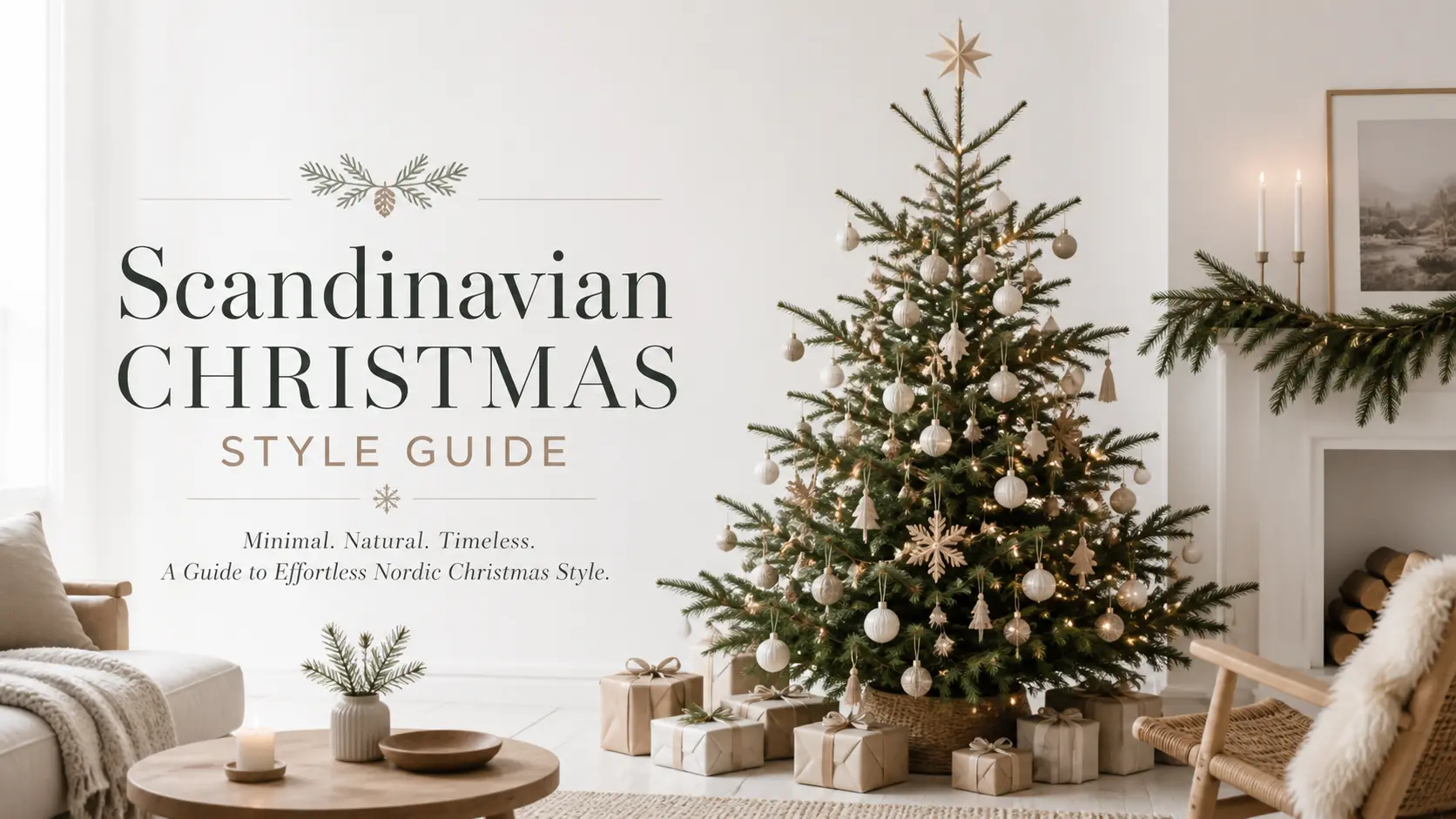

There is something quietly compelling about a Scandinavian Christmas tree. It does not demand attention. It does not glitter from across the room or overflow with ornaments. Instead, it draws you in slowly, the way a candle does on a dark winter evening. The appeal is in its restraint, its warmth, and the sense that every element on the tree was chosen with real care.
Nordic Christmas decor has been growing steadily in popularity well beyond Scandinavia itself. In a season that often encourages excess, people are increasingly drawn to the opposite direction: fewer pieces, natural materials, soft colors, and a calm that feels genuinely restorative. The Scandinavian approach to holiday styling offers all of that, and this guide walks through exactly how to achieve it.
What Is a Scandinavian Christmas Tree
A Scandinavian Christmas tree is, at its core, a study in intentional simplicity. The style draws from the broader design philosophy of Nordic countries, particularly the concept of hygge, the Danish and Norwegian idea of coziness, comfort, and warmth in small, meaningful things. On a tree, this translates into natural materials, muted tones, handmade elements, and a deliberate avoidance of anything loud or overwrought.
The Scandinavian holiday tree does not try to impress. It tries to belong. It fits into its room the way a good piece of furniture does: quietly, purposefully, and with a sense that it has always been there.
If you are looking for a starting point to explore trees that suit this aesthetic, christmastree.deals offers a wide range of natural-looking artificial trees that work well as the foundation for Nordic-style decorating.
Key characteristics of the Scandinavian style include:
- Natural and handmade ornaments over mass-produced plastic decorations
- A restrained color palette built on white, beige, soft gray, and natural green
- Warm, soft lighting that creates a glow rather than a blaze
- Negative space treated as a design choice rather than an oversight
- Texture and material variety achieved through wood, paper, dried botanicals, and linen
Choosing the Right Tree for Nordic Style
The tree you choose sets the tone for everything that goes on it. For Scandinavian styling, the goal is a tree that looks as close to natural as possible without requiring the annual hassle of a real one.
Natural-Looking Green Trees
A classic, full-bodied green tree with realistic branch variation is the most versatile base for Nordic decor. The natural color of the tree itself is part of the palette, and a good-quality artificial tree with PE needle tips mimics the texture and tonal variation of a real spruce or fir convincingly enough that it reads as organic from across the room. Avoid trees with silver or frosted tips, which introduce an artificial sheen that competes with the natural material aesthetic.
Pre-Lit Trees for Soft, Even Lighting
Lighting is one of the defining features of the Scandinavian holiday style, and a pre-lit tree with warm white lights built into the branches is the most reliable way to achieve the soft, even glow the style depends on. Pre-lit Christmas trees distribute light from the inside out, creating a warmth that comes from within the tree rather than sitting on its surface. This inside-out illumination is difficult to replicate convincingly by adding lights afterward.
Large Statement Trees for Open Spaces
In a room with high ceilings or an open-plan layout, a taller tree carries more visual presence without needing additional decoration. Scale works in your favor in the Scandinavian style because a larger tree means more branch space and therefore more room to breathe between ornaments. 10-foot Christmas trees can anchor a living room or entryway with understated drama, particularly when paired with minimal decor and clean surrounding space.
For homes with limited floor area, a slim or pencil tree is the more practical option. This guide on slim and pencil Christmas trees for small spaces covers how to choose the right profile for tighter rooms without sacrificing the aesthetic.
Scandinavian Color Palette
Color choice is where Scandinavian Christmas tree styling diverges most clearly from most other decorating traditions. The palette is not simply neutral; it is specific, deliberate, and rooted in the natural landscape of northern winters.
White and Off-White
Pure white and soft off-white tones form the backbone of the Nordic palette. White paper stars, white linen ribbon, white candle-style lights, and white or cream felt ornaments all belong here. The effect is clean without being cold, especially when layered against the natural green of the tree.
Beige and Warm Sand
Beige, warm sand, and natural linen tones add depth to an all-white palette without introducing any real color. Wooden ornaments in unfinished or lightly stained natural wood land in this tone range, as does dried botanical material like wheat, dried orange slices, and cinnamon sticks.
Soft Gray
Soft gray works as the cool counterpoint to warm beige and white. Gray felt ornaments, woven gray ribbon, and pale birch wood elements all bring a subtle coolness that keeps the palette from reading as purely warm and vanilla.
Natural Green Tones
The tree itself provides the primary green, but small additions of natural green, eucalyptus sprigs, dried fir bundles, or sprigs of rosemary tucked into branches, reinforce the botanical quality of the overall look.
Subtle Metallic Accents
A Scandinavian Christmas tree is not devoid of shine, but any metallic element is handled with restraint. Brushed gold or tarnished silver, not polished or mirror-finish, adds a quiet gleam without disrupting the calm of the palette. A few glass ornaments or simple brass bells are enough. Any more than that and the tree begins to move toward a different aesthetic entirely.
Scandinavian Christmas Tree Decorating Ideas
The following decorating approaches sit at the heart of Nordic holiday styling. Each one reflects the underlying philosophy of simplicity, quality, and connection to natural materials.
Wooden and Handmade Ornaments
Wooden ornaments are the most characteristic element of a Scandinavian Christmas tree. Traditional shapes, stars, hearts, small houses, reindeer silhouettes, and trees within trees, in unfinished or lightly stained wood bring warmth and texture without any visual noise. Their appeal is in the handmade quality they carry, even when they are machine-cut, which gives the tree a sense of human care and craft.
Look for ornaments made from birch, pine, or other light-toned woods. Unpainted or simply waxed finishes are truer to the aesthetic than painted or varnished surfaces.
Paper Decorations
Paper decorations have a long and genuine history in Scandinavian Christmas traditions. The Froebel star, sometimes called the Nordic star or German star, is a flat, folded paper ornament made from strips of paper woven together into a three-dimensional geometric shape. It is beautiful, mathematically precise, and entirely handmade. A cluster of these in white or natural kraft paper, hung at different heights across the tree, carries significant visual weight despite being made from almost nothing.
Paper cones, folded paper hearts in the Danish tradition, and simple origami shapes also fit naturally here. The material itself, soft, light, and organic in texture, suits the overall direction perfectly.
Neutral Ribbon Styling
Ribbon on a Scandinavian tree is understated and functional rather than decorative. Thin strips of natural linen, undyed cotton twine, or soft gray grosgrain ribbon can be used to hang ornaments or gather small bundles of dried botanicals to branches. Wide velvet bows have no place in this style; the ribbon here is more utilitarian than ornamental.
If you do use ribbon as a visual element rather than just as a hanger, keep it in a single thin width and use it sparingly. A few lengths of natural jute or undyed linen draped loosely through the branches rather than wound tightly around them is as far as the style tends to go.
Soft Warm Lighting
Lighting deserves its own section below, but as a decorating element it is worth noting here that the light on a Scandinavian tree is never about brightness. It is about warmth. A tree with 150 evenly distributed warm white lights that glow softly in a dim room is more in the spirit of this style than one blazing with 500 cool white LEDs in full afternoon light.
Nature-Inspired Decor
Dried oranges, cinnamon sticks, star anise, small pinecones, sprigs of dried lavender, and dried apple slices all belong on a Scandinavian Christmas tree. These botanical elements bring scent, texture, and an unmistakable sense of the natural world into the home. They can be tied directly to branches with twine, wired into small clusters, or hung individually.
Dried orange slices in particular have become closely associated with the Nordic aesthetic. They are simple to make at home, they hold their shape and color well on the tree, and they smell gently of citrus and warmth. A handful of them distributed through the lower two-thirds of the tree adds something no manufactured ornament can replicate.
Minimal Ornament Approach
Perhaps more than any specific type of ornament, the defining characteristic of Scandinavian Christmas tree decorating is knowing when to stop. The tree is never full in the way a traditionally decorated Christmas tree is. Gaps between ornaments are expected and intentional. The space between a wooden star and the next ornament along the branch is as much a part of the design as the star itself.
A practical approach: hang everything you plan to use, then remove a quarter of it. The tree will look better.
Lighting in Scandinavian Trees
Lighting in the Scandinavian tradition is almost sacred in its seriousness. Nordic winters are long and dark, and the use of light indoors during the holiday season carries real cultural weight. This is the context in which to understand why soft, warm lighting matters so much in this style.
Warm White Only
The color temperature of your lights should be warm white, between 2200K and 2700K. Anything cooler produces a blue or neutral tone that reads as clinical rather than cozy. The lights should suggest candlelight, which was the original light source in Scandinavian Christmas tradition, rather than overhead fluorescents.
Soft Glow, Not Harsh Brightness
The goal is a glow that is visible and warm but not dominating. If the first thing you notice when you look at the tree is the lights themselves rather than the tree as a whole, the lights are too bright or too numerous. Dimmer switches, if available, are worth using on pre-lit trees or light strands that support them.
Clean and Evenly Spaced
Scandinavian styling values order and balance. Lights wound unevenly, clustered in some areas and thin in others, create a visual restlessness that undercuts the calm the style depends on. Take the time to distribute lights evenly before any ornaments go on. On a pre-lit tree this is already handled; on a tree where you are adding your own lights, wind them into the branches rather than around the outside of them.
Scandinavian Style vs Other Christmas Tree Aesthetics
Understanding how Scandinavian style relates to adjacent decorating traditions helps clarify what it is and what it is not.
Compared to Farmhouse Style
Farmhouse Christmas tree styling shares some material overlap with Scandinavian decor: natural wood, buffalo check ribbon, pinecones, and neutral tones all appear in both. But farmhouse styling is warmer, more rustic, and often more abundant. It embraces a collected, well-lived-in quality that Scandinavian style deliberately avoids. Where farmhouse leans into layered abundance, Nordic style leans into restraint. This piece on why farmhouse Christmas trees are having a moment explores the farmhouse approach in more depth.
Compared to Minimalist Style
Minimalist Christmas tree styling is perhaps the closest cousin to Scandinavian decor, but the two are not identical. Minimalism can be cold and austere; Scandinavian style is always warm. A minimalist tree might use one type of ornament in a single color for graphic impact. A Scandinavian tree uses fewer ornaments too, but chooses them for their texture and handmade quality rather than for visual uniformity. This guide on minimalist Christmas tree ideas is a useful complement if you want to explore the cleaner end of that spectrum.
Compared to Luxury Style
Luxury Christmas tree styling and Scandinavian styling operate from almost opposite values. Luxury prioritizes visual impact, premium materials, and a staged grandeur. Scandinavian styling prioritizes quiet warmth, natural materials, and the comfort of understatement. A gold-and-crystal tree in a formal living room is about as far as you can get from a birch-wood-and-dried-orange tree in a candlelit corner. This overview of luxury Christmas tree decorating ideas shows the contrast clearly.
Placement and Styling Tips
Where and how you position the tree affects the entire feel of the space, and in Scandinavian design, the relationship between the tree and the room around it matters as much as the tree itself.
Keep the Surrounding Space Clean
A Scandinavian Christmas tree placed in a cluttered corner loses most of its impact immediately. The style depends on clean surroundings. Clear the area around the tree before it goes up. Remove anything from nearby shelves, surfaces, or walls that competes visually with the tree. The empty space around it is part of the composition.
Use Natural Light as a Complement
Position the tree where it can benefit from natural daylight during the day and where its warm lights are most visible after dark. Near a window is often ideal, as natural light reinforces the organic quality of wooden and botanical ornaments during the day, while the contrast between the tree’s warm glow and the dark winter window behind it is particularly beautiful in the evening.
Position the Tree as Part of the Room Design
In Scandinavian interior design, the Christmas tree is not a temporary intrusion into the room. It is placed and styled as though it belongs there, like a piece of furniture. Think about the sightlines from the room’s main seating area, from the entry, and from the kitchen if the rooms are connected. Position the tree where it is visible from the places where the household naturally gathers.
For narrow spaces or rooms with limited floor area, a pencil tree placed thoughtfully in a corner can have the same considered quality as a large statement tree in an open room. This guide on how to style a pencil Christmas tree in a corner addresses that specific setup in practical detail.
Budget-Friendly Scandinavian Christmas Decor
One of the most genuinely appealing things about the Scandinavian style is that it is inherently low-cost. The materials that define it are among the most affordable available, and much of what goes on the tree can be made at home.
DIY Ornaments
Paper stars are free to make from strips of paper or thin card. Salt dough ornaments, made from flour, salt, and water, can be cut into Nordic shapes and baked at home. Air-dried clay circles stamped with simple patterns and hung with twine cost almost nothing. The handmade quality of these pieces is not a compromise; it is the point.
Natural Materials from Outside
Pinecones gathered from the ground, small branches of dried eucalyptus, cinnamon sticks from the kitchen, and oranges or apple slices dried in the oven are all free or nearly free. Tied to branches with natural twine, they contribute the same visual quality as purchased botanical ornaments.
Simple Handmade Ribbon and Twine
Natural jute twine from a hardware store, unbleached cotton ribbon, and strips of linen fabric from an old shirt all serve as ribbon and ornament hangers in this style. There is no need to purchase expensive wired ribbon. The simpler the material, the more at home it looks on a Scandinavian tree.
Invest Only Where It Matters
If there is one area worth spending money in this style, it is on the tree itself and on the lights. A realistic, well-made tree and a set of warm white pre-lit lights are the foundation everything else rests on. The ornaments and botanicals can be almost entirely handmade or gathered without affecting the overall quality of the result.
Common Mistakes to Avoid
Overdecorating
The single most common mistake people make when attempting a Scandinavian Christmas tree is adding too much. The style is not simply about using natural materials; it is about using few of them. If the tree looks full, it probably has too much on it. Remove some pieces and reassess.
Using Bright or Flashy Colors
Red and green, jewel tones, bright metallics, and neon accents all break the palette immediately. Even a single bright red ornament on an otherwise perfectly styled Scandinavian tree draws the eye in a way that disrupts the calm the style depends on. Stay strictly within the muted, natural palette.
Ignoring Balance and Spacing
Even with minimal decoration, the placement of what is on the tree matters. Two ornaments clustered together on one branch and a long stretch of bare branches next to them looks unfinished rather than minimal. Distribute pieces evenly, step back often, and adjust for balance before considering the tree complete.
Using Cheap Plastic Ornaments
Plastic ornaments, regardless of their color, carry a manufactured quality that reads as out of place in a style built around natural materials and handcrafted texture. Even a plain plastic ball in white or beige looks wrong here. If you need budget ornaments, make them from paper, dough, or clay rather than buying plastic.
Over-Lighting
Too many lights, or lights that are too bright, push the tree away from the warm, intimate quality the style aims for. Less is more with Scandinavian lighting, just as it is with everything else on the tree.
Frequently Asked Questions
What kind of ornaments go on a Scandinavian Christmas tree?
Wooden ornaments in natural or lightly stained finishes, paper stars and cones, dried botanicals like orange slices and cinnamon sticks, simple glass balls in white or clear, and handmade salt dough or clay pieces all fit naturally. The common thread is that every element should feel natural, handmade, or both.
Do Scandinavian Christmas trees use tinsel?
No. Tinsel is entirely at odds with the Scandinavian aesthetic. The style avoids anything synthetic, flashy, or visually busy, and tinsel is all three. Natural twine, linen ribbon, or thin cotton string serve the same structural purpose without breaking the palette.
What is the difference between Scandinavian and Nordic Christmas decor?
The terms are often used interchangeably, and for practical decorating purposes they describe the same aesthetic: natural materials, muted tones, warm lighting, and minimal ornamentation. Strictly speaking, Nordic includes countries beyond Scandinavia, such as Finland and Iceland, but the visual style across these decorating traditions is essentially consistent.
Can I use a white or flocked tree for Scandinavian style?
A lightly flocked tree, one with a subtle dusting of white rather than a heavy coating, can work well in this style, particularly with a champagne and white palette. A fully bright white or heavily flocked tree tends to read as more contemporary or luxury-adjacent than authentically Nordic. This overview of decor ideas for flocked trees explores how flocked trees can be styled in different directions.
How many ornaments should a Scandinavian Christmas tree have?
There is no fixed number, but far fewer than you might expect. A 6-foot tree might carry 20 to 35 ornaments, widely spaced, with significant empty branch space between each piece. The goal is never coverage; it is curation.
Is Scandinavian Christmas decor suitable for small apartments?
It is particularly well suited to small spaces. The style does not depend on scale or volume; a small, beautifully styled tree with a handful of natural ornaments in a studio apartment is as true to the aesthetic as a large tree in a spacious home. The simplicity of the approach scales down without any loss.
Final Thoughts
The Scandinavian Christmas tree style is, at its most essential, a reminder that less can genuinely mean more. In a season that often tips toward excess, the Nordic approach offers something quieter and, for many people, more meaningful: a tree that is beautiful because of what it does not have as much as what it does.
If you have never tried this style before, start simply. Choose a natural-looking tree, string it with warm white lights, and add only what you truly want to look at. A few wooden stars, some orange slices tied with twine, a paper star near the top. Then stop. Live with it for a day before adding anything else.
You may find you do not need to add anything at all.